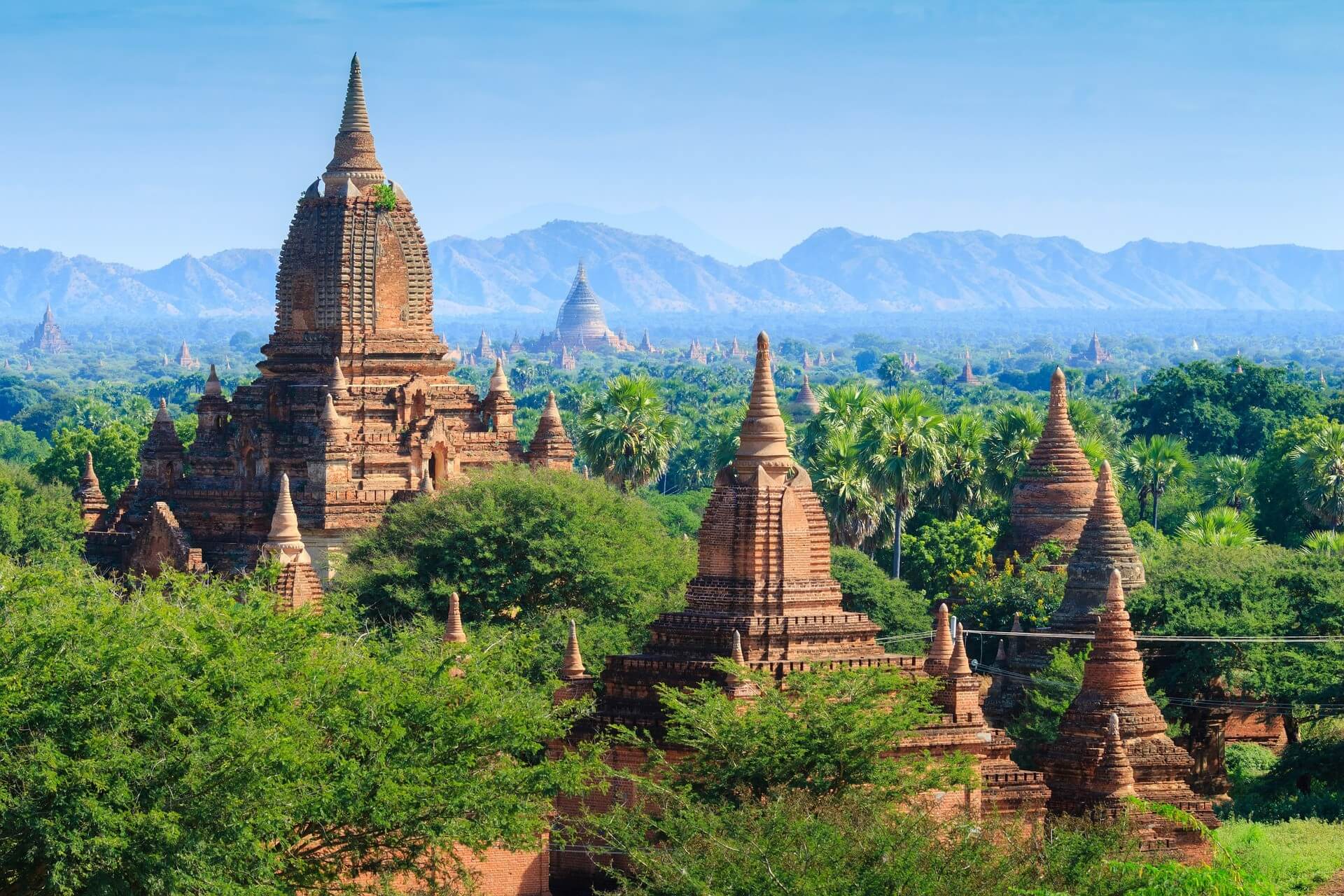
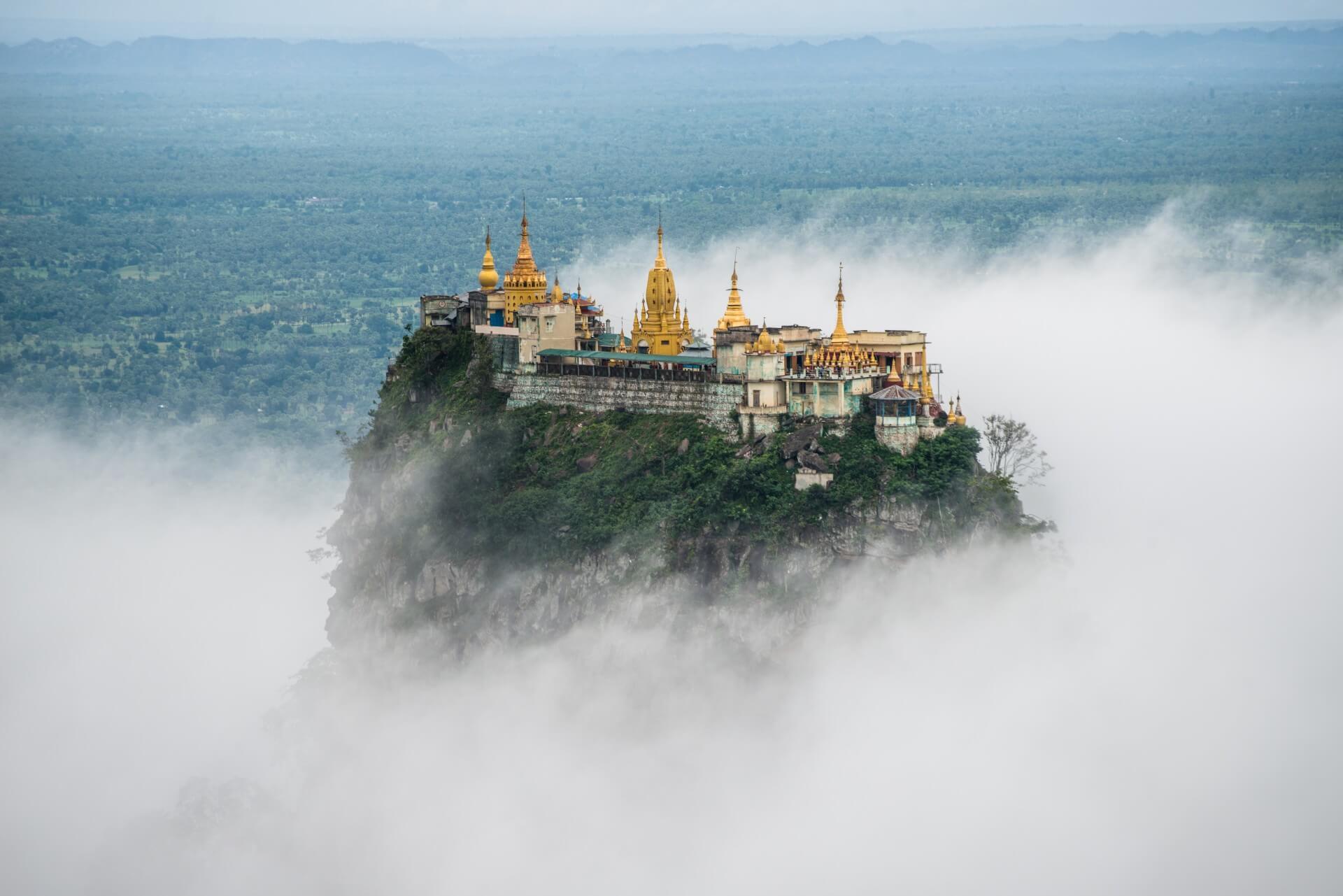
Every year, at the end of the rainy season, Burmese devotees are seized by a kind of spiritual fervor. Confident that they have accumulated many merits during the monsoon months, they seek to gain even more to ensure a favorable reincarnation in their next life. For this, there is a reliable method: going on pilgrimage and visiting one or several prestigious Buddhist sites, such as Shwe Set Taw, which was discovered long ago by a tiger hunter…
Guy Lubeigt – In partnership with the magazine Gavroche Thailand
Going on a pilgrimage in Myanmar in search of the most prestigious Buddhist sites
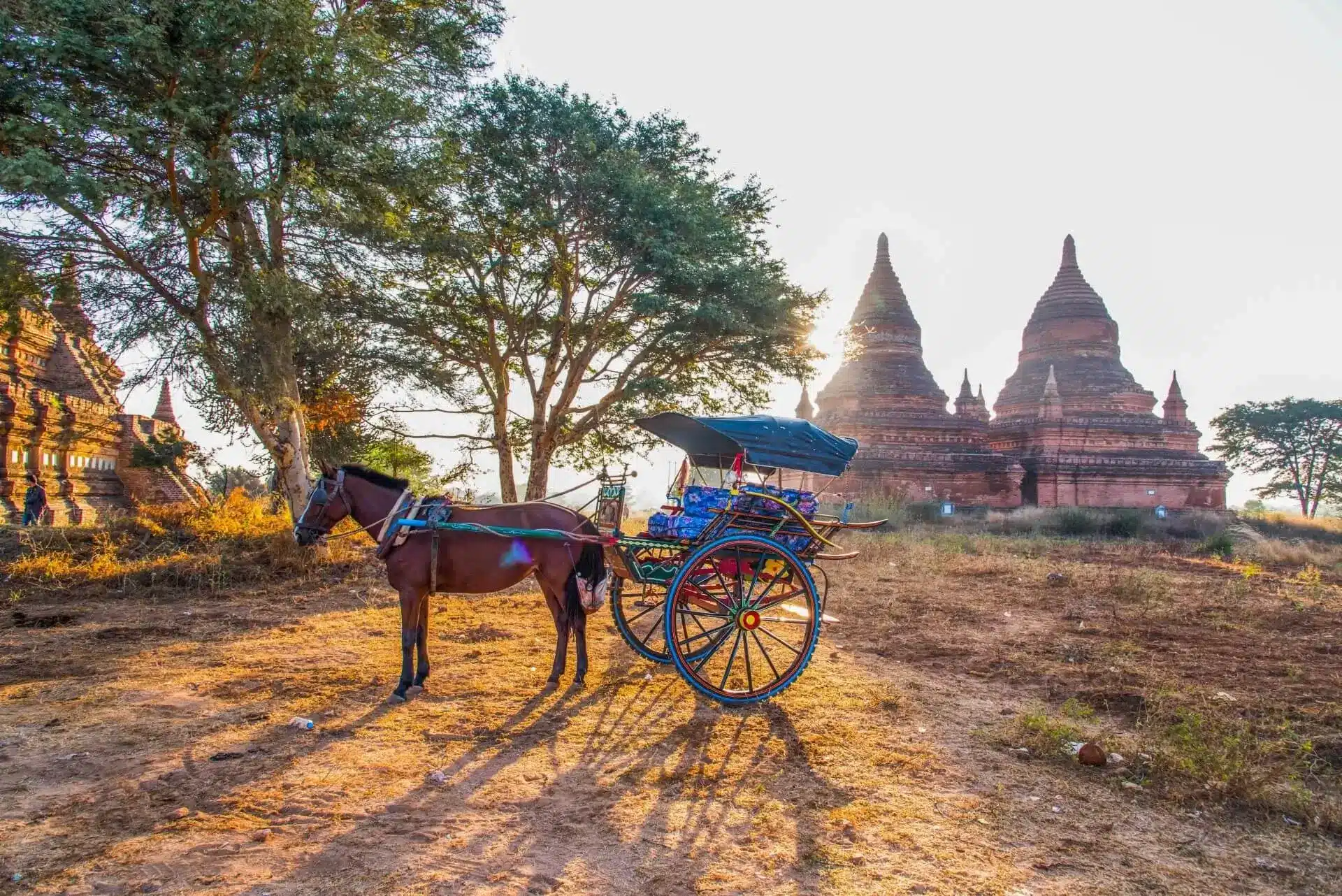
Places of worship are abundant in Buddhist Myanmar. From the delta plains of the coastal regions to the mountains and plateaus of the peripheral areas, and through the dry hills and winding rivers of central Myanmar, the country is dotted with sacred sites—each more remarkable and unusual than the last.
These can be found on the summit of an extinct volcano (Mount Popa), on a golden rock balancing on an eroded cliff (Kyaikhtiyo), on a rocky islet in the Indian Ocean (Mortizon), in a cave filled with Buddha statues (Pindaya), in a ravine hiding a gateway to a sacred treasure (Alaungdô Kassapa), or beside a lake sheltering five Buddha images believed to possess magical powers (Phaung-Dô-Ou). In the hills of Pho Win Taung, hundreds of rock-cut temples decorated with murals reveal another extraordinary spiritual site.
One article would not be enough to list them all. Burmese pilgrims believe they accumulate merit by paying homage to Buddha statues found at these pilgrimage sites. After kneeling with their hands joined in prayer for a respectful moment—usually no longer than a minute—they slip a donation into the offering box placed nearby. After all, many other sites still await them. A typical pilgrim can visit up to ten in a single day.
At the end of such a journey—often spent crouched in the back of a truck alongside fifty fellow pilgrims—it is usually pointless to ask what exactly they saw or the names of the pagodas they visited…
The footprints of the Buddha
During the dry season, major national pilgrimages attract hundreds of thousands of devotees who follow in the footsteps of the Buddha. The pilgrimage of Shwesettaw holds particular importance because, according to legend—no pilgrimage exists without one—the Buddha once came to this forest crossed by the Mann River at the foot of the Arakan mountain range.
Knowing he should leave a trace of his passage for posterity, he did even more: he left two footprints. One lies along the riverbank, the other on the top of the hill facing it.
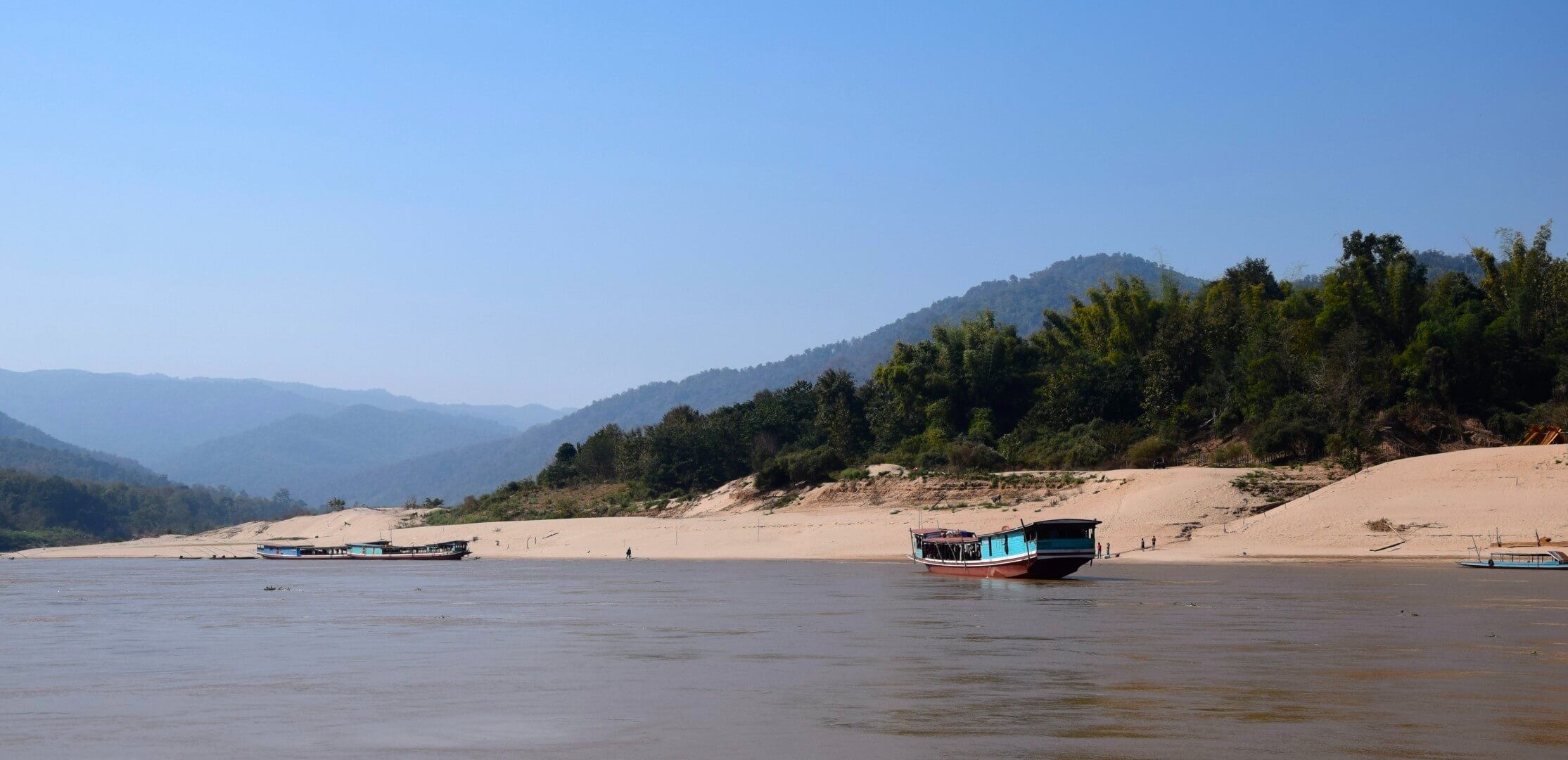
The site stretches across both sides of the Mann River, a capricious torrent that struggles to escape the Arakan range before flowing into the Irrawaddy about sixty kilometers to the west. The site was miraculously discovered by a tiger hunter in the seventeenth century. At that time, Indochinese kings eager to legitimize their power sent expeditions throughout their kingdoms to find the footprints of the Buddha.
Thus the famous footprint of Saraburi in Siam—about 100 kilometers northeast of Bangkok—was also discovered and is still revered by Thai devotees today. In those days, tigers still roamed the forests of Arakan. While searching through the tall grass along the Mann River bank, the hunter discovered the first footprint, two meters long, imprinted in the rock. News spread quickly.
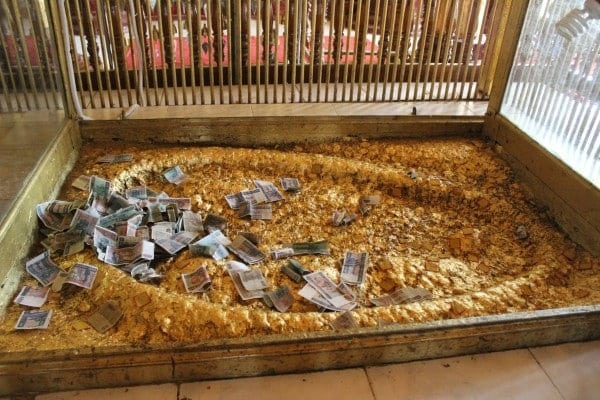
Pilgrims soon began to arrive in large numbers. Later, a small temple was built to protect the footprint, which is submerged during the rainy season when the river floods. Today, devotees cover the sacred mark with gold leaves during the dry season, ensuring it remains permanently gilded.
Concerned about his hunt, the tiger hunter crossed the shallow river and climbed the steep hill rising about one hundred meters along the opposite bank. At the summit, while ignoring the curious macaques watching from the cliffs, he discovered that the Buddha’s compassion had extended even further: a second footprint had been left there. Its much smaller size, however, suggests that the Enlightened One may have struggled slightly to stretch across the river while leaving both marks!
A rudimentary welcome
Regardless, such details hardly concern the pilgrims. The pagoda administration committee (Gopaka) has built collective dormitories—long wooden houses—and small bungalows where travelers can spend the night on bamboo mats, often crowded together.
Blankets and mosquito nets are not provided. In an effort to improve comfort, the Gopaka recently built around twenty bamboo huts along the river, offering slightly better conditions and even toilets for wealthier pilgrims.
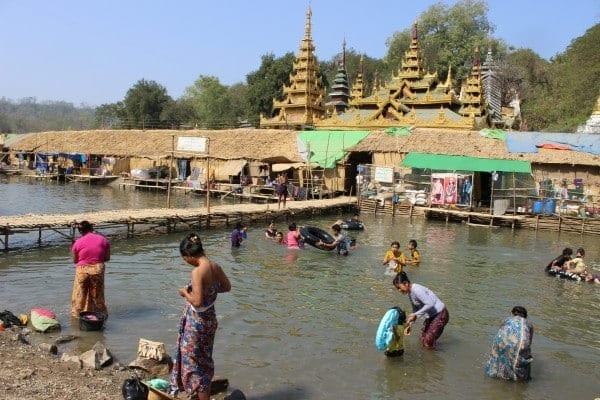
These bamboo houses stand either within the riverbed itself or along its banks, where the water flows peacefully during the dry season. In the widest part of the riverbed, the stones serve as a natural roadway, and dozens of shops line narrow corridors along the main walkway.
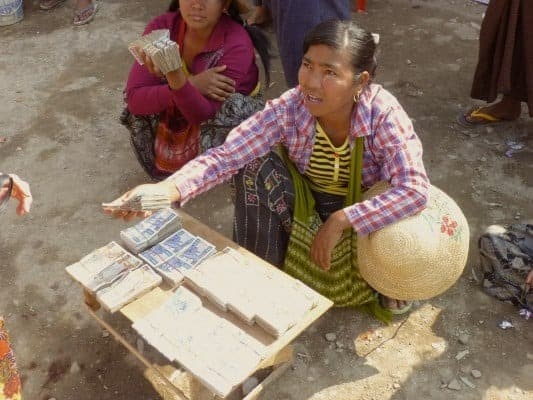
The administration offices are located at the base of the hill near four large staircases that lead to the summit. As in most pagodas, vendors line the steps selling fruit, soft drinks, offerings, sunglasses, souvenirs, clothing, and many other goods.
The permanent fair also includes restaurants, food vendors, vegetable sellers, donation collectors for monks, discreet security personnel, carpenters, textile sellers, and even rental stands for inner tubes used for bathing in the river.
Photographers once thrived here by capturing visitors’ moments, but their business is declining as smartphones have become widespread—even among rural women who now post selfies from the site thanks to the strong mobile signal. Each year, the temporary town along the Mann River expands further, now stretching over two kilometers.
Three to four months of festivities

Originally, the pilgrimage served as a meeting place for trade between mountain tribes and people from the plains. Rice, animal skins, dried fish, textiles, weapons, and tools were exchanged during this seasonal gathering.
Today the traditional fair has grown immensely, attracting merchants from across the country. They occupy accommodation areas, cook food in temple courtyards, and set up stalls throughout the site. Unlike most festivals, Shwesettaw lasts three to four months.
Over time the pilgrimage has even evolved into something resembling a “spiritual seaside holiday.” Visitors can safely swim in the river, bamboo bridges connect both banks, and trucks and buses cross the river during the festival to serve the growing town.
Happiness in the fields…
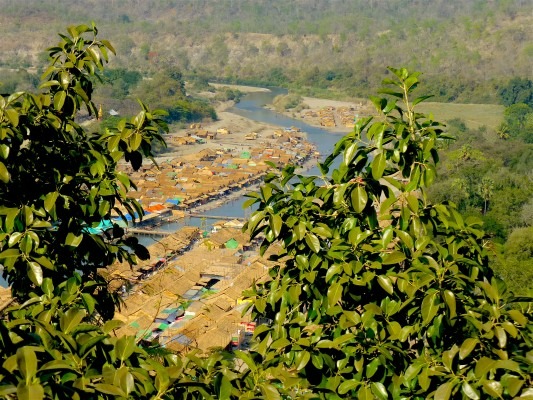
Observing the pilgrims’ behavior leaves little doubt about their deeper motivations. Officially, they come to pay homage to the Buddha. Unofficially, many simply enjoy a few days of relaxation far from crowded cities and the intense heat of central Myanmar. The cool waters of the Mann River are especially popular with children.
Over time the temporary settlement has become quite prosperous. Yet the concentration of tens of thousands of visitors along the riverbanks also raises sanitation concerns. Public toilets are limited and often paid, while makeshift facilities built from bamboo shelters serve others free of charge.
The city of Shwesettaw is temporary by nature. Each year it disappears when the Mann River swells again with the monsoon rains. A powerful typhoon about twenty years ago caused a sudden flood during the festival, destroying bamboo structures, washing away bridges, and leaving several casualties.
Since then, the festival—beginning in January—now ends in late March to avoid such risks. Waste collection services have also been implemented to protect the riverbanks.
As the writer Alphonse Allais once imagined, the Burmese have achieved something remarkable: creating a city in the countryside. It worked perfectly at Shwesettaw—but when they built the capital Nay Pyi Taw, relocating government employees proved much harder. After all, there was no pilgrimage nearby…
Guy Lubeigt – gavroche-thailande.com
Learn more here: https://asiajettravelusa.com/destination/birmanie/